
Licking County Court Calendars Explained
Licking County has no single all-court calendar. That surprises people. Each division keeps its own schedule. So a General or Domestic setting in Common Pleas starts with the case docket itself. The Common Pleas Clerk's remote-access channel usually refreshes during business hours at 15-minute intervals. But after the June 2025 platform conversion, the clerk offers no standalone guide to the current calendar fields. Treat a docket event as your starting point. Then confirm any setting that matters with the court or clerk directly.
Municipal Court posts calendar links for Courtrooms 1, 2, and 3. The city Mayor's Courts keep separate schedules. Which calendar applies depends on the court name printed on the case document, never on a county or city guess.
Licking County Municipal Calendar Guide
The Licking County Municipal Court calendar page states plainly that its courtroom calendars serve only as a guide. Each judge's office, or Small Claims Court, holds the official calendar. That local rule explains something practical. A docket entry online can lag behind the most recent setting. Use the page to locate your matter first. Then ask the office that keeps the official calendar whenever an entry looks out of date.
| Published calendar | Assigned official | Official calendar location |
|---|---|---|
| Courtroom 1 | Judge B. Matthew George | Judge’s office |
| Courtroom 2 | Magistrate Teresa Liston | Judge’s office |
| Courtroom 3 | Judge David N. Stansbury | Judge’s office |
| Small claims matters | Small Claims Court | Small Claims Court office |
Newark's city site links official Google calendars too. It notes, though, that the judge's office controls the official calendar. A guide can support a court docket search, but it never replaces the controlling court calendar.
Finding Your Court Date
Before opening any docket search, read the citation, summons, or written court notice in hand. It names the exact court, the case number, and the stated appearance date. Remember that a new filing or a reset can make an older screen result stale. The reliable path runs through the court's own docket. Then use its calendar or a direct confirmation from the clerk.
- Identify the court and division on the notice. Do not select a court by city name alone.
- For Common Pleas, search the available case docket through the clerk’s public route and allow for its normal update interval.
- For Municipal Court, use the court-linked records access, then use a courtroom calendar as a guide.
- For Pataskala, search the separate Mayor’s Court docket by ticket, case, name, or date; use Granville and Reynoldsburg city court channels for their cases.
- Read the newest event for a completed, continued, canceled, or rescheduled status.
- Confirm uncertainty by phone or at the clerk’s counter and preserve the court’s written notice.
Phone numbers for the courts: Common Pleas General, 740-670-5791; Domestic, 740-670-5392; Municipal, 740-670-7800. The Mayor's Courts can be reached at Pataskala, 740-927-3361; Granville, 740-587-2338; and Reynoldsburg, 614-322-6804.
Licking County Common Pleas Date Changes
The June 2025 Common Pleas platform change makes the current docket and clerk confirmation far more trustworthy than habits formed on the old schedule screen. That legacy system let you filter a schedule date range, event type, and presiding official, then displayed the date, time, case number, event type, courtroom or facility, presiding official, and status. Those are still useful categories for reading a setting. Just remember they describe an old interface, not a promise about present fields.
The current remote-access notice warns that maintenance and outages can occur. If a Common Pleas hearing is close and the portal is down, skip the older web results. Call the relevant clerk or court office instead.
How to Read a Court Setting
A setting is the scheduled event plus its court context. The legacy Licking calendar inventory used date, time, case number, event type, courtroom or facility, presiding official or judge, and status. Read those fields together, always. A date without its status might be an old event, and a setting label without the latest docket entry can hide a later change.
| Date and time | When the event is listed to occur; verify a later reset or notice. |
|---|---|
| Case number | Connects the calendar row to the correct case docket. |
| Event type | May identify arraignment, bond hearing, conference, plea, sentencing, trial, or another event. |
| Courtroom or facility | Shows the listed location, which should be checked against the current notice. |
| Presiding official and status | Help show who controls the setting and whether the event remains active. |
Licking County Court Setting Language
Schedule terms show the stage of a Licking court case. That is all they show. They may not tell you whether an appearance is required, whether the case is complete, or whether the hearing has moved. The underlying docket and the court's notice resolve those details.
- Arraignment
- An initial appearance or plea stage; Pataskala uses it for first or continued appearances.
- Bond revocation or modification
- A criminal setting on release conditions.
- Case management conference
- A court-directed progress or scheduling event.
- Change of plea and sentencing
- A combined proceeding that must be read with the resulting entry.
- Non-oral hearing
- A legacy event label that should not be presented as an in-person appearance without a court notice.
Continuances, Resets, and Cancellations
A continuance or reset moves a setting. The newest docket entry controls over any earlier listed date. Pataskala offers a clear example of local practice. Its court requires a personal visit for a continuance request at least 24 hours before the setting. It takes no telephone continuance requests. It may also allow one one-week rescheduling without penalty when there is good cause and no prior continuance.
Pataskala also posted a cancellation and rescheduling notice for an August 2026 session. That is a practical reason to check the docket and the court's current notice. Do not trust a weekly schedule copied from an earlier date.
Licking County Pataskala Court Dates
The Pataskala appearance schedule lists Thursday court starting at 1:00 p.m., with the clerk office closing after 12:30 p.m. that day. Miscellaneous hearings follow at 2:00 p.m. for Time Payment Program participants and diversion reviews. Arraignments come at 3:00 p.m. Trials begin at 4:00 p.m.
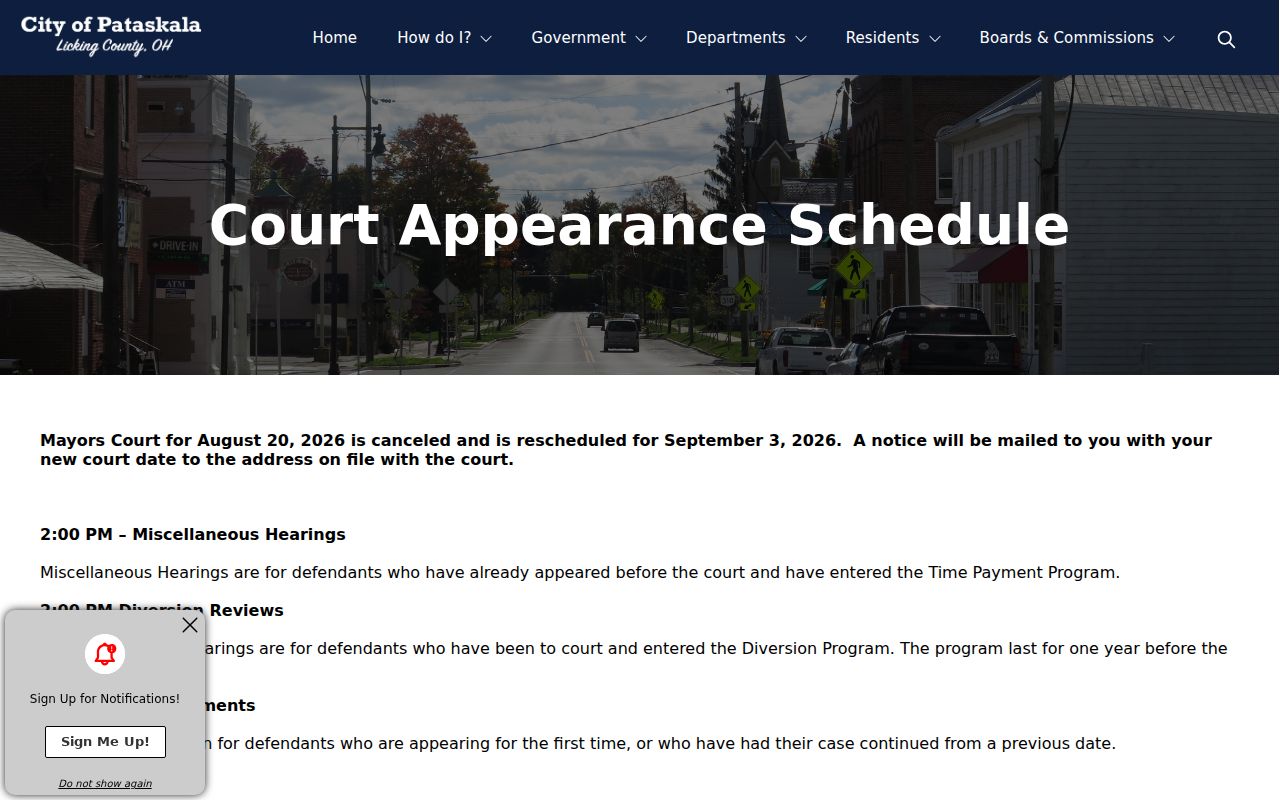
That schedule gives setting-type context only. Your citation, the docket, and the court's current notice pinpoint an individual court date. Granville normally sits Friday at 8:30 a.m. Trials typically come before a magistrate on the last Friday of the month. Reynoldsburg sits Thursday at 8:30 a.m., excluding holidays. The court warns that staff may be less available by phone on court day.
If You Miss a Court Setting
A missed setting is not fixed from the sidelines. Use your notice and the case docket to identify the court, then call or visit the clerk who controls that docket. Reynoldsburg warns people directly on this point: a voicemail is neither an approved continuance nor an appearance. Leaving one does not erase your duty to appear.
Act promptly. A missed traffic or criminal setting can have court-specific consequences. Pataskala warns that failure to appear may lead to a warrant, a registration block, and a possible license forfeiture sent to the BMV. The precise result depends on the case, court, order, and current law.
A published calendar can't prove the setting never happened. Ask the clerk for the case's current status, and follow the court's instructions for whatever comes next.
Licking County Court Date Confirmation
In Licking County, confirming a court date follows a simple chain. Start with the court's notice. Then find the right case docket. Check a published calendar where one exists, and confirm with the official court or clerk. Common Pleas uses its clerk's remote records channel. Municipal Court sends you from guide calendars to the judge's office or the Small Claims Court. Mayor's Courts add city schedules and clerks.
The chain exists for a reason. Dates are not interchangeable across courts. An online result can be delayed, and it can be revised after the fact. Match the case to its named court every time you check a court date.
For a Common Pleas matter, start with the General or Domestic case docket. Identify the division before calling. For a Municipal matter, keep the published courtroom guide separate from the judge office. That judge office controls the official calendar. For a Mayor's Court citation, use the city docket or schedule only after confirming the exact city court on the ticket. The clerk can explain what an entry means. It may be a scheduled hearing, a completed event, a continuation, or a cancellation.
Keep the court's written notice after a confirmation. A dated notice plus a current docket entry gives court-specific context. A broad weekly schedule cannot do that. This matters most after a reset, a recent filing, a portal maintenance period, or a court-day office-availability change.
Pataskala's Thursday schedule makes this point. A court date needs its event type to mean anything. Its page separates time-payment and diversion reviews at 2:00 p.m. Arraignments come at 3:00 p.m., and trials at 4:00 p.m. Granville lists a Friday Mayor's Court, and Reynoldsburg holds a Thursday sitting. A weekly schedule cannot fix your assigned session. Only the citation or docket can do that.
Common Pleas adds a division question. The General Division Clerk and the Domestic Clerk keep separate offices and separate phone contacts. Bring the case number and division to every step. That keeps your court-date inquiry from landing with a clerk who does not hold the Licking case.
The Municipal calendar rule also teaches a lesson about status. Courtroom 1, 2, or 3 narrows the likely setting. A judge office can confirm whether it was held, moved, or canceled. For Small Claims Court, use the Small Claims office as the official calendar source. That office-level check is narrower than scanning every county court calendar. Yet it answers the question a current court-date search actually raises.
When a court calendar and a docket entry differ, trust the latest dated case entry. Which notice controls the Licking setting? The court or clerk can confirm it.